Product · October 28, 2026
Smart Problem List 2.0: from pilot to daily practice
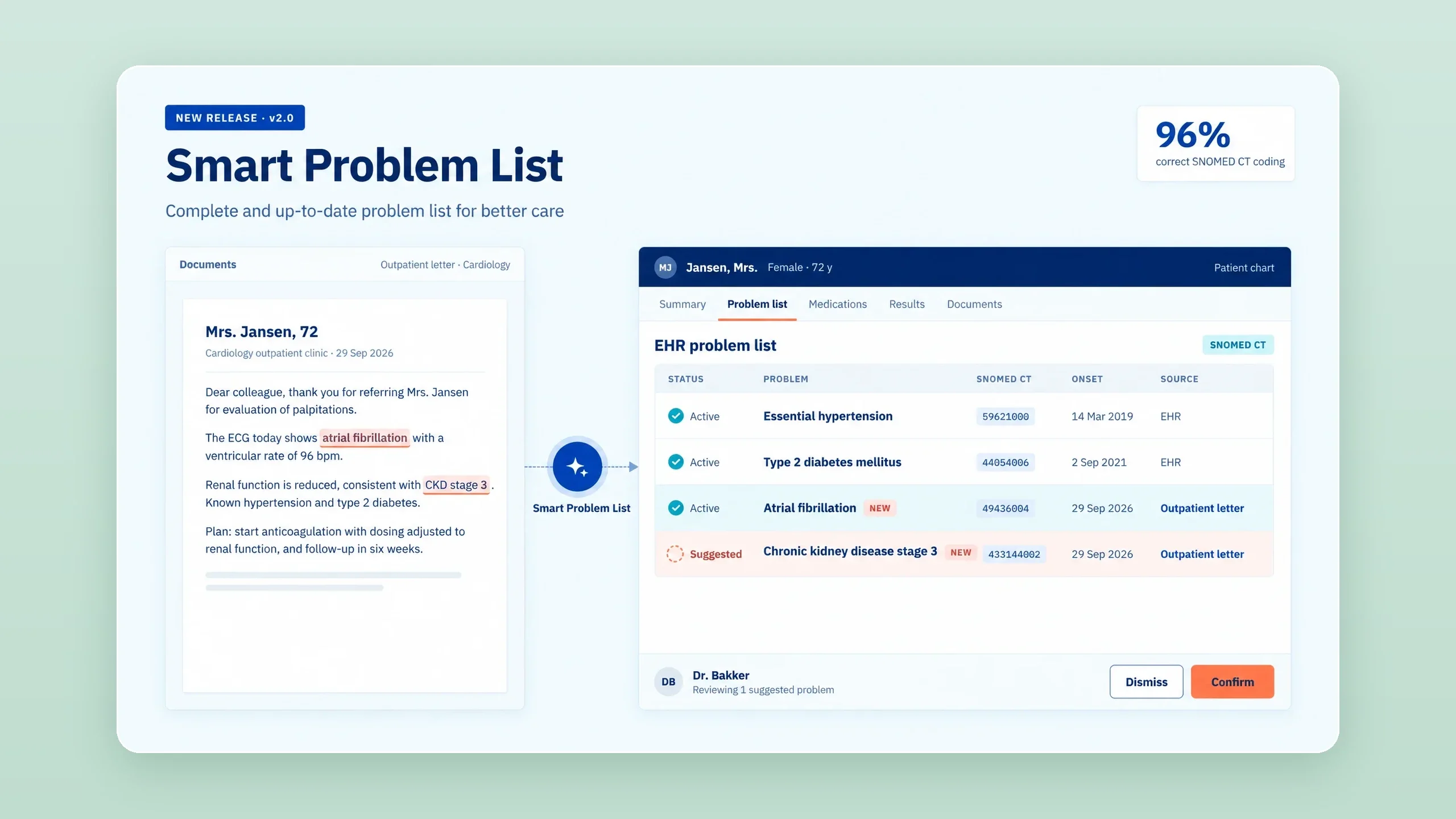
Every treatment decision starts with knowing the patient. Yet in most hospitals the problem list, which should be the most reliable summary of a patient’s health, is incomplete or out of date. The information is there, buried in clinical letters, but it rarely makes it into structured data. That costs doctors time and leaves hospitals with data they can’t reuse.
We built the Smart Problem List (SPBL) to change that. Today it is part of daily practice for medical specialists in hospitals in Benelux, fully integrated into HiX. Their feedback shaped version 2.0, now live.
What the Smart Problem List does
The Smart Problem List reads clinical letters and notes and proposes problem list items. The physician reviews every suggestion and decides what is added. Each problem is coded in SNOMED CT, so the problem list becomes structured, exchangeable and reusable. In daily use, doctors add on average 3 new problems per patient that were not yet on their problem list.
Suggestions are tailored to the specialty of the doctor using it. Take arthritis without a specified cause. The model won’t suggest it to a rheumatologist, because arthritis is a feature of many rheumatic diseases and is too non-specific for their problem list. For a cardiologist, however, the same finding can be relevant, for example because it may prompt a referral to rheumatology.
What’s new in 2.0
- A more intuitive interface: further optimized around how doctors review letters, so validating suggestions takes less time and fits naturally into the consultation workflow
- Improved SNOMED CT coding: 96% of suggested problems are now coded correctly even before the doctor validates them, so the data can be relied on for future decision making, exchange and secondary use
- Improved workflow: suggestions now appear faster, and the Smart Problem List is even more tightly embedded in HiX. Doctors review and validate without leaving their familiar environment, right when the patient is top of mind
Built to the highest standard: MDR certification
AI that becomes part of the patient record deserves the same rigour as any other medical software. That is why we are taking the Smart Problem List through CE certification under the European Medical Device Regulation (MDR). In practice this means a certified quality management system, documented clinical evaluation, full traceability from requirement to release, and continuous monitoring once in use. For hospitals, it means they can deploy the Smart Problem List knowing that its safety and performance have been independently assessed. We see this as the standard for AI in clinical workflows.
A building block for the complete patient picture
The Smart Problem List is more than a better problem list. Coded, validated problems are the first layer of something larger: a complete, structured picture of every patient, built from all the information a hospital already has. On that foundation, data exchange under the European Health Data Space, research, quality registries and every next AI agent can do their work. Because everything runs on the Coforix platform, hospitals connect once and can then add new AI models and agents without a new integration.
Version 2.0 is an important step towards that vision. We will share more about it soon.
Want to see the Smart Problem List in your hospital? Request a demo